As I've been hammering out the rules for 'Bastards, a topic has been eating me for a while. Since Higgins and I were unable to come up with a good solution, I thought I would offer it up for discussion here.Following this up with some broader-applicability to other games - I find this isn't an issue in OSR games specifically, or D&D games in general. After first the first couple levels, you generally have enough HP that a single crossbow bolt to the face isn't going to kill you, and even then in most D&D games death isn't permanent. Poisons lose a lot of their efficacy, because you can still try to make saves for them. In general, dungeon-crawling also usually means the characters are always on the lookout for something trying to kill them anyway.
We are going to define the word assassination in this discussion to mean "a situation in which the target is dead without a meaningful chance to prevent or react to it." The primary examples to be discussed are sniper shots and poison.
Both of these things are extremely effective in killing people. That is why they exist. It's realistic and good simulation that they should kill people pretty effortlessly when they happen, and it's fitting that the rules should encourage players to make use of them (if it is the sort of thing their character would do). After all, getting in a fair fight is usually a very poor tactic utilized by the foolish, idealistic, or desperate.
The problem is that this blade that should cut both ways, but in practice doesn't. Mechanically speaking, there's nothing stopping me as a GM from rolling some dice and announcing "Your conversation is cut short when the window shatters. Blood and brains fly out the back of your skull and splatter the wall behind you. A half-second later, your friends hear the report of a high-caliber rifle some distance away." The rules support it just like they do if it were a player character doing the same to an NPC.
The problem is that any GM who would actually do that out of the blue is ..well.. probably an asshole. For a game like 'Bastards to work, you have to have some kind of trust in your GM and killing a PC off without any meaningful chance to prevent it is a gross abuse of that trust. Poison is the same way. An option is always some kind of perception test to spot the sniper or detect the poison first, but even that seems grossly unfair when the fail-state of the test is "you die."
Thus in practice, this becomes an extremely strong tool for the PCs to use, but one that they are essentially plot-armored from ever receiving. At best, the GM is going to have to either intentionally miss the first shot, or an NPC winds up eating a bullet to alert the players to the danger.
In our discussion, Higgins did point out that we are primarily simulating fiction - not reality - and that protagonists very rarely die suddenly and without warning from assassination attempts (George R. R. Martin notwithstanding). This is a good point, but the counterpoint I offered was that the protagonists in fiction aren't aware of their own plot-armor. By contrast, players can generally trust that their GM isn't just going to kill them without a warning or a chance to prevent it - which has a strong tendency to translate into player-characters operating under the same assumption.
So the question we are forced to grapple with is "how does one balance assassination as a useful and effective tool for the PCs without making it so effective that it can never be used against them?"

Sunday, September 27, 2015
The Problem With Assassination in Role Playing Games
This is mirrored from a discussion the GH forums, but I thought I'd throw it up here as well. The discussion is specific to the way Band of Bastards works, but it applies to any game with moderate-to-high potential lethality.

Tuesday, August 18, 2015
The Brute - A Class for Lamentations of the Flame Princess (or other Old School Fantasy Games)
Brutes are freaks of nature. Whether mutations born of fell magic, unspeakable parentage, or some unseemly devolution, Brutes are born cursed and misshapen. Their bodies are twisted parodies of the human form. They are huge and powerfully built, in some ways closer to ape than man. They often possess secondary characteristics that put people off -
malformed or asymmetrical features, jagged teeth, unnaturally thick skin
or hunched backs.

When a human child is born a brute, they are normally slain at birth or left in the woods to die of exposure. When a child does survive to adulthood, they are changed for the experience. Their whole lives spent fighting for survival, they are in many ways closer to animal than human. Even when calm and personable, there is something unmistakably savage and predatory about them.
Brutes can use the same Fighter-class moves as Elves and Dwarves, but do not advance in Attack. For XP, and HP, use the table below.
As they advance in levels, they learn to better use their size and ferocity to their advantage. They increase their Strength Modifier and Sneak Attack when indicated on the table above. This could mean that even with only 14 Strength, a level 11 Brute could have a +4 modifier for all purposes.

When a human child is born a brute, they are normally slain at birth or left in the woods to die of exposure. When a child does survive to adulthood, they are changed for the experience. Their whole lives spent fighting for survival, they are in many ways closer to animal than human. Even when calm and personable, there is something unmistakably savage and predatory about them.
Brutes can use the same Fighter-class moves as Elves and Dwarves, but do not advance in Attack. For XP, and HP, use the table below.
| Level | XP | HP | Sneak Attack | Strength Mod |
| 0 | - | 1d10 | ||
| 1 | 0 | 1d10 | +1 | |
| 2 | 2,500 | 1d10 | ||
| 3 | 5,000 | 1d10 | +1 | |
| 4 | 10,000 | 1d10 | ||
| 5 | 20,000 | 1d10 | +1 | |
| 6 | 40,000 | 1d10 | ||
| 7 | 80,000 | 1d10 | +1 | |
| 8 | 160,000 | 1d10 | ||
| 9 | 320,000 | 1d10 | +1 | |
| 10 | 480,000 | 3** | ||
| 11 | 640,000 | 3** | +1 | |
| 12 | 800,000 | 3** | ||
| 13+ | +160,000/lvl | 3**/lvl | +1 |
Friday, July 31, 2015
House Rule: Duel Wielding
I've never liked the idea that duel-wielding gives you twice as many attacks. Having two weapons doesn't make you attack twice as quickly, and having two attacks per round is by comparison such a good option that it's almost always better than having the +1AC or whatever that a shield would have given you.
My current compromise:
This gives a slight bonus without being ridiculously better than a two-handed weapon or shield. I'd like to incentivize using smaller weapons with this - or at least, using something like "Sword and dagger" rather than "I'm duel-wielding longswords." I'd prefer to do it without having to resort to some kind of "one weapon has to be shorter than the other" kind of rule.
My current compromise:
When using two weapons, roll your attack as normal. If you succeed, roll the damage of each weapon. Keep the highest.
This gives a slight bonus without being ridiculously better than a two-handed weapon or shield. I'd like to incentivize using smaller weapons with this - or at least, using something like "Sword and dagger" rather than "I'm duel-wielding longswords." I'd prefer to do it without having to resort to some kind of "one weapon has to be shorter than the other" kind of rule.
Tuesday, July 28, 2015
Under/Over
Continuing my LotFP tinkerfest:
My biggest bugbear with the current setup is that some rolls are roll-over, others are roll-under. This bothers me, as players get confused as to which way the rolls should go.
As it stands, attack rolls and saves are roll-over. Ability rolls and skills are roll-under. I'd like to align them all in the same direction:
My biggest bugbear with the current setup is that some rolls are roll-over, others are roll-under. This bothers me, as players get confused as to which way the rolls should go.
As it stands, attack rolls and saves are roll-over. Ability rolls and skills are roll-under. I'd like to align them all in the same direction:
Option A: Roll Over
Move everything to a roll-over system. Attack rolls can stay the same (d20+AB vs AC). Saves would be the same (equal to or greater than your save number).
Ability Score would have to be roll 1d20+Ability. 21+ is success.
Skills would have to be 1d6+skill. 7 is success.
Benefits:
- Rolling high is by virtue of language and conditioning intuitively good. "Natural 20" automatically triggers something in most gamers.
- Ability Scores can be directly opposed, with each side rolling d20+Ability to determine the winner.
Drawbacks:
- Double digit+double digit math is something that will produce an "uhhhh" every time it is rolled.
- Defeats the point of recording skills in pips, as part of the charm was the visual representation on the sheet actually looking like the d6, and needing that or under.
- 21 and 7 sound arbitrary (even if they aren't), and begin to stray into TN/DC territory, which I'm not a fan of for this kind of game. The simplicity of roll-under is that what you see is what you need.
- Save numbers go down to improve instead of going up, which is slightly counter-intuitive.
Option B: Roll Under
Attribute and Skill rolls remain as they are now. Saves are easily converted to roll-under: you just take what they are now and subtract them from 20. A sheet could have the updated saves and no one would notice the difference.
Attack Bonus would need renamed (it's no longer a bonus), but is functionally the same. If you had +2 before, it would now just be a roll-under of 2. AC would go back to TSR era "lower is better."
Your attack roll would then be a d20 with the goal of rolling under your Attack Score+EnemyAC.
Bonuses can universally be assumed to apply to the score itself, rather than the roll, so a +1 bonus is still good.
At present, I'm liking B more than anything, but debating whether a return to a THAC0 style chart is better or worse than weird AC mechanics.Benefits:
- No math required anywhere except the attack roll, but that always needs math unless you want to make a chart (Note to self: consider chart). What you see is what you need.
- Pips on dice retain their charm.
- All Stats go up to improve - except for AC? Hrm.
- AC listed in other retroclones/TSR material can be used more or less as-is.
Drawbacks:
- "Roll low to succeed" is inherently less intuitive. "Natural 1" doesn't hit the brain the same way as "Natural 20."
- Enemy AC now modifies your roll, instead of being the target you need to meet. Not sure if this is less intuitive. Could be fixed through a THAC0 style table, but that goes back into "is this more or less intuitive than the alternative? If you did go that route though, AC could be positive as well.
Monday, July 27, 2015
LotFP Multiclassing/Hybrids
Last post, I was chewing on the way LotFP classes work. In the time between, I came up with the following. It needs some testing, but I like the idea:
Niche protection shouldn't be an issue. Each of the core classes will always be better at their job than the hybrids. There is slightly closer competition with the demihumans but each demihuman gets a benefit that the hybrids can't and they universally have a lower xp requirement for what they are trying to do.
The applications of the above create a lot of interesting concepts. Paladins or witch-hunters could easily be fighter/clerics or even cleric/specialists. Fighter/Specialist in particular opens up nice possibilities as a ranger or assassin. Magic-User/Specialist could even be used for a bard, god forbid.
I'll have to test this more before I decide if I like it, but it would actually handle most of the concepts I was considering making alternate classes for without deviating much from the core rules.
LotFP Hybrid Classes
In addition to the four traditional classes, human characters can instead choose to play a hybrid class. Each hybrid consists of a blend of two of the core classes, gaining some of the strength of each but not the full benefits thereof.
Pick two of the following to gain your core benefits:
Cleric: Casts Cleric spells as a cleric of half their level. Cannot be combined with Magic-User.
Fighter: Gains all fighter combat options and begins with a +2 Attack Bonus, but their attack bonus never increases.
Magic-User: Casts Magic-User spells as a Magic-User of half their level. Cannot be combined with Cleric.
Specialist: Pick two skills. Each of these begin at 2 dots. One of these may increase each level.
If the character is a hybrid class that has spells, they will for all rules purposes (spells per day, learning spells, spell effects) be considered a caster of half their level. If you are a Cleric/X hybrid at level 10, you will in all ways act as though you were a level 5 cleric for the purposes of magic rules. You begin with no access to spells at level 1.
Saves will be identical to one of the parent classes. The player may choose which.
XP will be equal to the highest XP class x1.5. Thus, to get to level two a Fighter needs 3000, Cleric needs 2625, Magic-User needs 3375.
Niche protection shouldn't be an issue. Each of the core classes will always be better at their job than the hybrids. There is slightly closer competition with the demihumans but each demihuman gets a benefit that the hybrids can't and they universally have a lower xp requirement for what they are trying to do.
The applications of the above create a lot of interesting concepts. Paladins or witch-hunters could easily be fighter/clerics or even cleric/specialists. Fighter/Specialist in particular opens up nice possibilities as a ranger or assassin. Magic-User/Specialist could even be used for a bard, god forbid.
I'll have to test this more before I decide if I like it, but it would actually handle most of the concepts I was considering making alternate classes for without deviating much from the core rules.
Friday, July 17, 2015
Classes in Lamentations of the Flame Princess
We started a new Lamentations of the Flame Princess campaign the other day. I really love the system, and it's become my go-to for OSR style play. As my players get into it though, I find the itch to tinker again. I always have the itch to tinker. Right now, my attention is on classes.
(TL;DR, skip down to "What I'm Thinking.")
The demi-human classes are somewhat less impressive, but each feel like a hybrid of something above.
When the class in question is doing the thing they are supposed to do, they roll two dice and take the better result. Fighters would roll 2d20 on their attack rolls, keeping the higher. Specialists would get 2d6 on every skill roll, only failing if both fail.
A Paladin class then could take on Lay on Hands or a similar feature and still have advancing AB, but lose their 2d20 roll. Other classes could have skills, or an Assassin class could exist with its own features, but only get 1d6 for skill rolls. It would also make the Specialist better at whatever skill than any of the demi-humans using that same skill.
I can't decide if this is the way I want to do it. I'm not sure if it would make the classes too good by comparison, but it's definitely something I want to play around with.
(TL;DR, skip down to "What I'm Thinking.")
What I love about LotFP Classes:
There is an extremely fine balance between the classes in the game. Each of the four human classes are good at and completely own a specific niche.- Clerics are the only ones with access to clerical magic, which already grants them a lot of really cool stuff including the extremely important healing abilities and turn undead.
- Fighters are the only class that gains AB as they go, as well as having access to better combat options (AC+4 on parry, Press and Defensive fighting). This is the only version of a D&D style game I've played where Fighters really feel indispensable as the fighting class.
- Magic-users get all of the eldritch goodies you'd expect, and some extremely flavorful spells.
- Specialists are the best thief variant I've seen in an OSR game. The ability to put dots where you please lets you play them as the ranger, the cat-burgler, the explorer, the assassin, or whatever else. More importantly, they are the only class who gets points to spend in increasing abilities.
The demi-human classes are somewhat less impressive, but each feel like a hybrid of something above.
- Elves are essentially fighter-mages, as they usually are. The interesting thing is that they don't get advancing AB the way Fighters do, but they do get the extra melee options.They do however get an ascending Search die as they level.
- Dwarves are treated much the same. No advancing AB, but they get the extra melee options, a larger hit-die, and can carry around more stuff. Stonecunning takes the form of an advancing Architecture skill.
- Halflings.. uh.. are. halflings. In LotFP, they wind up with a 5-in-6 Stealth skill, an ascending Bushcraft skill, and a bonus to their dex and AC. [Edit: Raggi himself dropped a comment on my G+ for leaving out the halfling's saving throw bonuses! Woops.]
What I Hate about LotFP Classes:
Each class is indisputably the best at it's specific niche, but those niches are fairly narrowly defined. In normal B/x, it's pretty easy to add in new classes because every class already gets better at multiple things. In LotFP as written, it would be extremely hard to introduce another combat class that wouldn't step on the Fighter's toes. Giving other classes much in the way of skills winds up making the Specialist a little less.. special.What I Want to Do:
I've got a few things I want to tinker around with but have held off because LotFP is on its own a pretty well-oiled machine. For instance - letting a character have some additional points to spend in their skills based on Intelligence modifier (Fighters wanting bushcraft is an obvious one. A dwarf in our current campaign made that exact request). I've also wanted to tinker in letting players specialize their character in one way or another - a Specialist variant that gets more offensive capabilities in exchange for reduced skill points; Paladin, Ranger, or Barbarian being Fighter variants that gain extra abilities in exchange for giving up some Fighter prowess; Variant or specialized magic users or clerics, and so on.What I'm Thinking:
Fighter and Specialist are the two classes I'm most concerned with, as their whole value comes from being the sole class that advances in their niche. If I give another class AB, or another class skills, their relative value goes down. To solve this, I'm considering the following:When the class in question is doing the thing they are supposed to do, they roll two dice and take the better result. Fighters would roll 2d20 on their attack rolls, keeping the higher. Specialists would get 2d6 on every skill roll, only failing if both fail.
A Paladin class then could take on Lay on Hands or a similar feature and still have advancing AB, but lose their 2d20 roll. Other classes could have skills, or an Assassin class could exist with its own features, but only get 1d6 for skill rolls. It would also make the Specialist better at whatever skill than any of the demi-humans using that same skill.
I can't decide if this is the way I want to do it. I'm not sure if it would make the classes too good by comparison, but it's definitely something I want to play around with.
Update: I have since come up with some potential solutions for all of this.
Tuesday, July 14, 2015
Time Flies
Has it been a month already? Man. Right. Updates:
Grand Heresy now has two youtube channels. Barbarossa has outdone himself with setting things up and getting our whole AV situation sorted. Grand Heresy Press is going to be our core channel, and we'll be uploading things on there as we get them recorded. We'll be throwing some updates on as we get closer to 'bastards release, but it for now primarily be the home of the Grand Heresy AP Podcast. More on that in a moment. Our secondary channel is Grand Heresy Presents, which will be a place we upload stuff that isn't directly related to role-playing games, but involves us or our interests. Barbarossa already has some footage about grilling, of all things. Neither channel has proper content up yet, but Barbarossa did an excellent job on the intros.
The Grand Heresy AP Podcast recorded some test footage. We just started a Lamentations of the Flame Princess one-shot and are basically recording our normal game footage. When we get it all situated, we'll be uploading the footage to youtube and ripping the audio as a downloadable podcast. Links to everything will eventually be up on our website.

If you didn't already know, because the group is so spread out, we're using Tabletop Simulator for our gaming. It is a huge improvement over Roll20. The mood and atmosphere are a lot better with TTS. It feels a lot more personal than the more clinical interface of Roll20, and having physical space with moving cameras lets you do a lot of things that are hard to do otherwise - using tokens to keep track of gameplay, having multiple maps or sheets out at the same time, etc. Most of all though, the dice. Roll20 has a terrible random number generator system. I have vivid memories of using it for Mordheim and deciding that it actually didn't matter what the stats of the characters were. Most d6 results were either 1 or 6, auto-fail or auto-succeed. TTS treats them as objects with a physics engine, so they roll as they should and produce the results you would expect. Even better? They make extremely satisfying noise when you shake them or clatter them across the table. I've been doing so much online gaming that I forgot how great that noise was, even through simulation.
If I had any criticisms of TTS, it's not particularly well-optimized for complex operations. It will start to tank when you have a high number of objects on the table, but for the most part it hasn't bothered me. It's also relatively early in its life-cycle, so future updates may improve this.

I've also started trying to force myself to piddle with art again. I make no claims towards professional talent, but I like to play with it. It's decent enough to render a character portrait now and then (like the above, from our LotFP group). If you're interested, I keep a tumblr for that purpose. Fair warning: I'm studying anatomy. There are naked people.
I've got some more stuff to post shortly, but that's enough for now.
Until next time,
Grand Heresy now has two youtube channels. Barbarossa has outdone himself with setting things up and getting our whole AV situation sorted. Grand Heresy Press is going to be our core channel, and we'll be uploading things on there as we get them recorded. We'll be throwing some updates on as we get closer to 'bastards release, but it for now primarily be the home of the Grand Heresy AP Podcast. More on that in a moment. Our secondary channel is Grand Heresy Presents, which will be a place we upload stuff that isn't directly related to role-playing games, but involves us or our interests. Barbarossa already has some footage about grilling, of all things. Neither channel has proper content up yet, but Barbarossa did an excellent job on the intros.
The Grand Heresy AP Podcast recorded some test footage. We just started a Lamentations of the Flame Princess one-shot and are basically recording our normal game footage. When we get it all situated, we'll be uploading the footage to youtube and ripping the audio as a downloadable podcast. Links to everything will eventually be up on our website.

If you didn't already know, because the group is so spread out, we're using Tabletop Simulator for our gaming. It is a huge improvement over Roll20. The mood and atmosphere are a lot better with TTS. It feels a lot more personal than the more clinical interface of Roll20, and having physical space with moving cameras lets you do a lot of things that are hard to do otherwise - using tokens to keep track of gameplay, having multiple maps or sheets out at the same time, etc. Most of all though, the dice. Roll20 has a terrible random number generator system. I have vivid memories of using it for Mordheim and deciding that it actually didn't matter what the stats of the characters were. Most d6 results were either 1 or 6, auto-fail or auto-succeed. TTS treats them as objects with a physics engine, so they roll as they should and produce the results you would expect. Even better? They make extremely satisfying noise when you shake them or clatter them across the table. I've been doing so much online gaming that I forgot how great that noise was, even through simulation.
If I had any criticisms of TTS, it's not particularly well-optimized for complex operations. It will start to tank when you have a high number of objects on the table, but for the most part it hasn't bothered me. It's also relatively early in its life-cycle, so future updates may improve this.
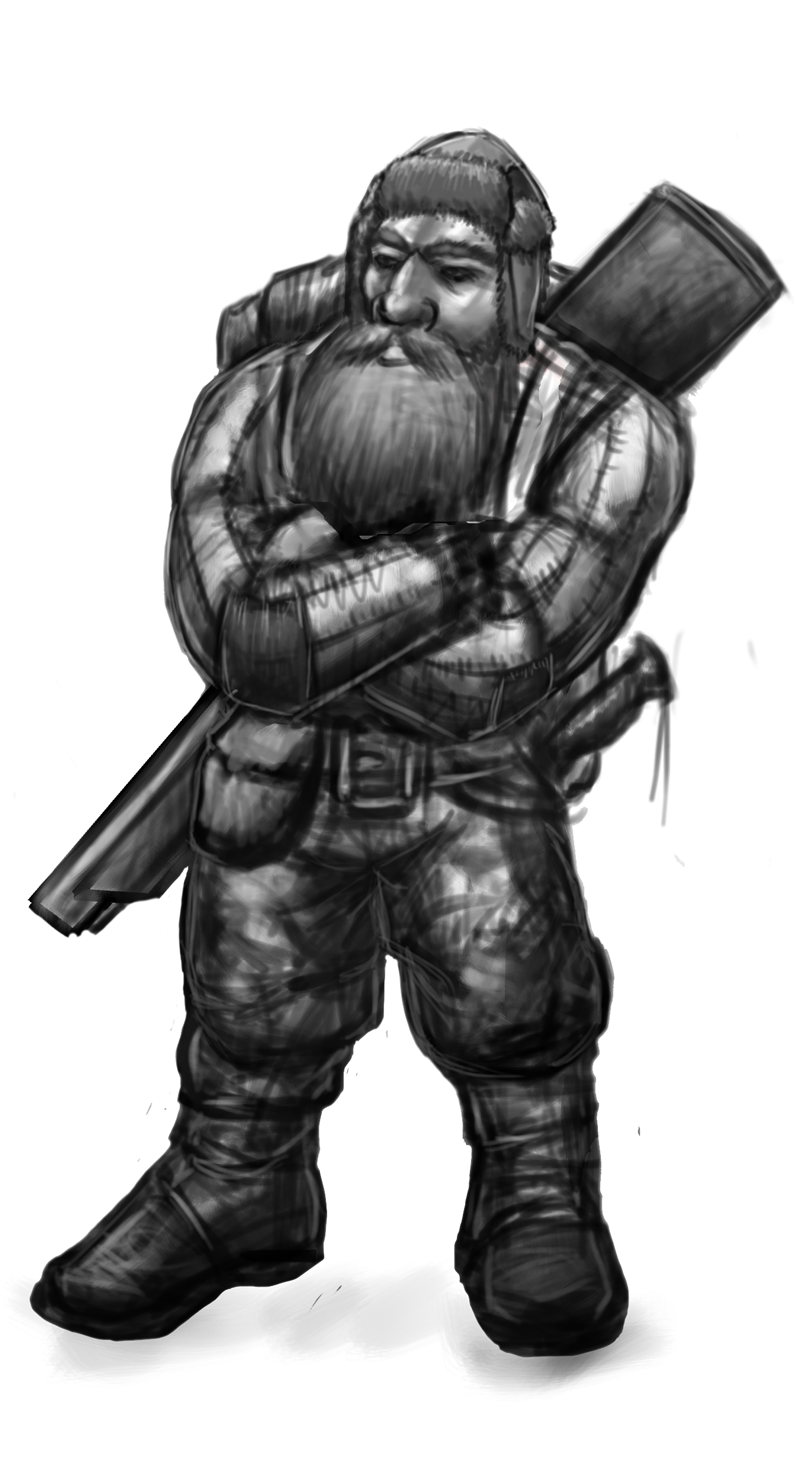
I've also started trying to force myself to piddle with art again. I make no claims towards professional talent, but I like to play with it. It's decent enough to render a character portrait now and then (like the above, from our LotFP group). If you're interested, I keep a tumblr for that purpose. Fair warning: I'm studying anatomy. There are naked people.
I've got some more stuff to post shortly, but that's enough for now.
Until next time,
Subscribe to:
Posts (Atom)