I first started playing RPGs by hacking together a functional game out of just what I could glean from the AD&D1e DMG. I later moved into Alternity, Cyberpunk, and then I was all over the place. Back then, I played games the way most people did—or maybe still do—without a hell of a lot of thought about design, "creative agendas" or any of that.
My big shift came when I discovered The Riddle of Steel. It was in many ways, unlike anything I'd ever seen. It completely challenged my ideas of what role-playing was or could be, how games should be run. The combat system was like nothing I'd ever seen. I had already been a major history nerd, but it was through TROS that I'd developed a love of HEMA and all that was entailed. I was too late to the party to be around when The Forge was kicking hornet's nests, but damned if I didn't pursue The Riddle.
The next big shift came for me in discovering Burning Wheel. This was nowhere near the paradigm shift that TROS was, but it was perhaps the clearest demonstration I've ever had of the idea that "system matters." In both my own Burning Wheel experiments and those I've watched/listened to (I have a weird fascination with actual play recordings) I've gained a huge appreciation for how the system influences and informs play.
At that point in my life, I don't think you would've been able to convince me to play D&D if you paid me. My few attempts to experiment with it again were... painful. My experiences with 3.x and pathfinder were abysmal. When 4th edition came out, I couldn't even finish my read of the player's handbook. Striker? Defender? Controller? Ugh. I couldn't get past the terminology. In my mind, it immediately left me thinking about MMOs. Would we be drawing aggro and baiting spawn points next? This is without touching that the game designated which classes were "leaders" of the party (we'll decide who leads our party among ourselves, thank you). Making this impression even worse, I watched Chris Perkins DM a 4e game on youtube. It was a four-hour session which took place entirely on a battle map. It started with the party in the dungeon with some exposition to put them there, followed by three or four combats interspersed with a couple skill challenges. Read: someone had to throw some dice at something. It took them four hours to run four fights. I wouldn't be playing 4th edition. (Later, I did actually come to appreciate it as a kind of combat-based dungeon crawling board game, I just wouldn't want to run it as a D&D game.)
The next weird step in my gaming evolution was encountering the practically unheard of Chronica Feudalis. This was a system I found so interesting and hackable that it actually prompted me to start blogging about it. The original blog those took place on has long-since been abandoned, though I've migrated several of the most interesting posts here. Oddly enough, one of which is in my "Popular nonsense" stuff on the sidebar, making it my number 2 most all-time viewed post. I guess someone out there has heard of this stuff after all.
What struck me most about CF was just how flexible it actually was. The structure of the wounds and maneuvers system gave me nearly as cinematic and bloody combat as I was getting from TROS (or, by this time, Song of Steel -- the game that would eventually be rebranded as Band of Bastards). Was it meant to be used in such a bloody faction? I have no idea, but some of the most bloody and cinematic combats I've ever played were in a hacked version of Chronica Feudalis.
Perhaps the most radical departure for me in this was just how simple it actually was, by comparison. How quickly it played and how little effort as a GM it took to run. I can safely blame Higgins for introducing the game to me. I had previously been playing a great deal of Savage Worlds specifically because it was relatively simple for players to wrap their head around. When I'd argued for SW to be a relatively rules-light game (how naive I was!) Higgins scoffed and rightly put me in my place. He may have been nicer than that, but I certainly remember there was scoffing.
This is when I bumped into the OSR movement for the first time. I had already had a lot of fond memories of AD&D as a kid. For whatever reason, I never really mentally categorized those experience into the same box as my encounters with 3.5 or 4e D&D. They seemed like completely different kinds of games. It wasn't until I started getting into the OSR scene that I understood why. They were fundamentally different types of games. Whatever one might say about indie games and The Forge, the whole culture will get you thinking about how games are designed and played, even if you disagree with their conclusions.
I was hooked pretty quickly. I'm not sure if it was my newfound craving for simplicity, a touch of nostalgia, or that the games so openly embraced a lot of things that I'd sort of lost sight of from in
Somewhere between my newfound craving for simplicity, a touch of nostalgia, and an open embrace of a lot of things I'd lost sight of somewhere along the way. Likely, all of the above.
I have to really credit the OSR scene for bringing a lot of balance back to my gaming tastes. There's a lot of people out there who like to try to pit indie/nar/forge types as being in one camp and OSR as being two opposite and non-overlapping things, each vying to be the One True Way and the other being badwrongfun. I've gained a lot from both communities and I greatly enjoy both kinds of games. They provide radically different experiences, and in a lot of ways follow the same "system matters" ethos. In a curious way, they even both seem to be a response to the same thing - dissatisfaction with "Adventure path" (read: railroad) style of GMing and systems that are bad at what they are supposed to be doing.
I actually had a reason for going into all of this besides my own nostalgia. I have a handful of topics that have been digging at me for a while now, but I thought they could use some context before I began. Unfortunately, this post is far too long already. So those will wait until next time.

Showing posts with label Chronica Feudalis. Show all posts
Showing posts with label Chronica Feudalis. Show all posts
Saturday, August 6, 2016

Monday, November 17, 2014
Chronica Feudalis: Updated Mentor List
I did a series of Chronica Feudalis mods a while back, but I realized I never shared the updated table. This is what I used below for the game, balanced to be compatible with the blue version of the book.
 |
Image via DeviantArt
|
An updated Mentor list for the revised (blue) version of the rules. I added some items or item choices, changed a couple skills from core, and added a couple altogether new mentor categories. Some of these deviations were made with my upcoming campaign in mind, so your mileage may vary.
While it isn't spelled out in the book, assume that equipment from the same mentor type doesn't stack. Taking Knight, Knight, Knight may make you a terrible force in battle, but you don't get three horses for having done so. Your specialization gives you higher skills than anyone else, but you get fewer skills and less variety in equipment for having done so.
Everyone has the option of a free knife / dagger (d4) at character creation.
Mentor
|
Taught Skills
|
Gifted Tools
|
Archer
|
Aim, Dash, Sense
|
Longbow (d8) or crossbow (d10), quiver of arrows (d10)/bolts, Gambeson or leathers (d4)
|
Artisan
|
Entice, Sense, Will
|
Toolkit (d6), purse (d6)
|
Clansman
|
Brawl, Fend, Strike
|
Handaxe (d6) and Roundshield (d10) or Longaxe (d10), Half-helm (d4), Boots (d6), hardened leather cuirass (d6)
|
Courtier
|
Command, Deceive, Entice
|
Expensive outfit (d6), purse (d6)
|
Doctor
|
Command, Heal, Will
|
Surgeon’s kit (d6), bandages (d4)
|
Guard
|
Fend, Sense, Will
|
Spear (d8), round shield (d10), leather jerkin (d4)
|
Hunter
|
Aim, Hide, Hunt
|
Bow (d6), quiver of arrows (d10), snare trap (d4)
|
Knight
|
Fend, Ride, Strike
|
Helm (d6), horse (d20), mail hauberk (d8), kite shield (d12) and arming sword (d8) or Longsword (d10)
|
Merchant
|
Deceive, Entice, Ride
|
Cart (d8), mule (d10), purse (d6)
|
Minstrel
|
Dash, Entice, Perform
|
Drum, flute, harp, or lute [pick one] (d8)
|
Monk / Friar
|
Dash, Sense, Will
|
Robes (d6), stylus and ink (d6)
|
Noble
|
Command, Will, Ride
|
Expensive outfit (d6), horse (d20), purse (d8)
|
Nun
|
Entice, Heal, Will
|
Habit (d6), prayer rope (d4)
|
Outlaw
|
Fend, Hide, Strike
|
Hand weapon (d6)[choose one], Dark Cloak (d6), Gambeson / Leathers (d4)
|
Peasant
|
Brawl, Dash, Sense
|
a hand tool [pick one] (d6), hard shoes (d6)
|
Priest
|
Command, Entice, Perform
|
Holy text and device (d6), vestments (d6)
|
Prostitute
|
Deceive, Entice, Perform
|
Provocative dress (d6), uncomfortable shoes (d6)
|
Sailor
|
Boat, Brawl, Swim
|
Map (d6), rope (d6)
|
Soldier
|
Dash, Fend, Strike
|
battle axe or spear(d8), boots (d6), coif/ half-helm (d4), leather cuirass (d6) round/heater shield (d10)
|
Thief
|
Climb, Sneak, Steal
|
Dark cloak (d6), lock picks (d6), soft shoes (d6)
|
Tuesday, October 28, 2014
Chronica Feudalis: A Horse is a Horse (Item Aspects)
This was a rule that was inspired by Pixar's Brave, weirdly enough. Something about the way the characters were portrayed charmed me, but it was the horse in particular that got me thinking. This was a rule that got a fair bit of use in our home campaign, and I thought I would share it here.
Item Aspects
While the single-die tool system provides an easy way to handle most items and their uses, sometimes you want a little more depth for a unique or unusual item, making them something of a character themselves.
The most obvious application (and inspiration) for this is in dealing with animals, such as horses or dogs. In addition to their die as tools, the animal may possess aspects of their own. A great clydesdale horse may have Giant Draught Horse, or your horse could have Unusually Clever, Stubborn as a Mule, Trained Warhorse, Built for Speed or Mean as Hell. Canine aspects are endless as well. Hunting Dog, Lazy, Hound of War, Loyal, Half-Wild, and Ferocious Appearance are all good examples.
This could also be used to represent items of with unusual qualities, such as magical items or other tools of unusual characteristics. Particularly significant items may have more than one aspect. One can quickly imagine a ring with the aspects Concealment d12, Longevity d8, Sought after by the Enemy d12, and Will of its Own d8.
Players may invoke aspects of animals or tools at their disposal by paying a point of ardor as though they were invoking one of their own, but must also endure the aspects of their items, when applicable. Finally, the GM can compel the aspects of objects under player control. The danger is that these compels cannot be 'bought off' in the way that player compels are, though they still earn ardor for the player in question.
At the GMs discretion, certain objects may grant bonuses on their own. The enchanted sword Elvenbane might have the aspect Hatred of Elves d8 that automatically fires whenever the weapon is being wielded against an elf. Such weapons would be very powerful tools, by CF standards, and should be used sparingly, if at all.
It should be up to the GM and his players whether dice earned in this way should count towards the vigor limit of the player invoking the aspect. If not, then tool aspects become very powerful factors. If so, then balance is struck with other aspects of the system, but the vigor cap may wind up preventing the tool aspects into coming into play in many situations.
The above gives some basic suggestions, but the idea can establish a precedent that can be used in countless ways, from animals to weapons and armor to ships and vehicles - any time you want to elevate a tool from an item to a character of its own.
 |
| Via Deviantart |
While the single-die tool system provides an easy way to handle most items and their uses, sometimes you want a little more depth for a unique or unusual item, making them something of a character themselves.
The most obvious application (and inspiration) for this is in dealing with animals, such as horses or dogs. In addition to their die as tools, the animal may possess aspects of their own. A great clydesdale horse may have Giant Draught Horse, or your horse could have Unusually Clever, Stubborn as a Mule, Trained Warhorse, Built for Speed or Mean as Hell. Canine aspects are endless as well. Hunting Dog, Lazy, Hound of War, Loyal, Half-Wild, and Ferocious Appearance are all good examples.
This could also be used to represent items of with unusual qualities, such as magical items or other tools of unusual characteristics. Particularly significant items may have more than one aspect. One can quickly imagine a ring with the aspects Concealment d12, Longevity d8, Sought after by the Enemy d12, and Will of its Own d8.
Players may invoke aspects of animals or tools at their disposal by paying a point of ardor as though they were invoking one of their own, but must also endure the aspects of their items, when applicable. Finally, the GM can compel the aspects of objects under player control. The danger is that these compels cannot be 'bought off' in the way that player compels are, though they still earn ardor for the player in question.
At the GMs discretion, certain objects may grant bonuses on their own. The enchanted sword Elvenbane might have the aspect Hatred of Elves d8 that automatically fires whenever the weapon is being wielded against an elf. Such weapons would be very powerful tools, by CF standards, and should be used sparingly, if at all.
It should be up to the GM and his players whether dice earned in this way should count towards the vigor limit of the player invoking the aspect. If not, then tool aspects become very powerful factors. If so, then balance is struck with other aspects of the system, but the vigor cap may wind up preventing the tool aspects into coming into play in many situations.
The above gives some basic suggestions, but the idea can establish a precedent that can be used in countless ways, from animals to weapons and armor to ships and vehicles - any time you want to elevate a tool from an item to a character of its own.
Monday, October 27, 2014
Chronica Feudalis: Economics
The least-sexy of the equipment expansions, but a bugbear to battle no less, particularly after the Weapons and Armor posts.

There's a weird tendency in fantasy to eschew cost when working things out in the world. No, I'm not talking about the protagonist having things beyond his means - he's the protagonist. I mean as a whole, throughout the world. I can't count how many battle scenes I've read or watched where every last combatant had maille and plate and a sword or two at their side. This isn't objectively bad, but if you are going to sell me on a world of Lords and Dukes and Feudal structure, you should probably take some time to consider what that means.
Good equipment has always been prohibitively expensive. In the viking age, having a sword or maille was the sign of a veteran - even a chief - as only the most wealthy and powerful could afford that much iron and steel. In the crusader era, we see a similar pattern: having a sword forged would cost more than a car today, and a well-made maille hauberk would be worth more than your house. A true war-horse? Ferrari, sir. Ferrari. Eventually, the west discovers better ways to heat and make steel bringing the cost of metal arms down, but like apple products today the prices never really go down; the toys just get more advanced and the rest of us just hope the outdated things entered our price range.
The down-side of the one-die system to rate all of the equipment is the same as my essential qualms with D&D's gear listing: the cost of things is dependent on how 'powerful' they are, not how much they actually cost to make. This is definitely one way to do it, but we already have some weirdness. In vanilla CF, spears and swords are both rated at d8. This is fine for combat, and even for defense, but do they cost the same? Though any soldier worth his rations would have been familiar with spear-work, spears were the standard weapon of peasant militia specifically because they were so cheap to make by comparison. Part of the mystique of the sword has been that it was a hero's weapon. A chieftain. A knight. Someone who wasn't a dirty peasant. In most eras throughout history, swords were relatively rare on the battlefield compared to the number of men with spears, daggers, axes and modified farm tools. It isn't until right before the era of plate that steel production became cheap enough to allow such blades to be regularly acquired by the ignoble.
We can find similar issues elsewhere in our weapons list: the club or staff is generally just a bit of carved (or uncarved) wood. Halberds were weapons issued en masse to guards and infantry.
Labor Costs
Due to cost of labor and materials with the technology of the day, certain items cost more or less than their die would suggest. They may have one of the following tags applied to them. If an item is not tagged, you can assume that it costs the normal amount.
Worthless items are those that can be just as easily made by yourself and may be purchased at up to 2 steps lower than their list cost, to a minimum of d4. However, in most cases, given the opportunity and resources a character could fashion such an item themselves. These items generally do not have a barter or resell value.
Simple items are those that are readily available and fairly inexpensive. They may be purchased for one die step lower than their listed die.
Complex items are those that are extremely expensive to make or purchase and represent a significant investment in the character's personal wealth. These items are generally made specifically for the person. Rare items generally don't sell below a d12 or d20, regardless of what their die listing is.
A little knowledge of history will go a long way with this one. In a viking setting, maille will be a d12 easily and a finely made sword is a king's ransom at d20 - a thing of chiefs, kings, and heroes. By the crusader era, an arming sword could drop to d12, and you might even let the hauberk slip to d10 if you were feeling generous. Spears and (when available) halberds are generally Common items. Clubs and Staves are worthless. Use common sense when applicable. I may create a full price list for my campaign later, but for now I think this serves well enough.
An Alternate Take
After discussing this with a friend of mine, he came up with a simpler way to handle the whole thing. Use either method.
Use the dice as listed normally, but keep all item purchases in-character (thus the GM can price appropriately). Use the following guidelines:
Trading with items works the same as trading with the Purse, except for the item put forth into the trade should be at least equal die value than the item that one hopes to gain. Also, as items are kind of generic in value, the GM should agree that the trade is reasonable. If the protagonist's roll succeeds, he will lose his item of course, as the change of goods occurs. If the roll fails however, the other party will not agree to the trade for whatever reason. Retries are possible, but the protagonist must make a better offer, which means that he should either offer another item for trade with a higher die type, or combine his current offer with other items to make the die value go up as per purse rules.
If the initial trade item value is d20 (it can't go up), then at least a d8 value item must be added to the retry, then an additional d10 item for the next retry (can't be combined up from d8) and so on.
Characters with applicable aspects (Shrewd Trader) can invoke them here.
There's a weird tendency in fantasy to eschew cost when working things out in the world. No, I'm not talking about the protagonist having things beyond his means - he's the protagonist. I mean as a whole, throughout the world. I can't count how many battle scenes I've read or watched where every last combatant had maille and plate and a sword or two at their side. This isn't objectively bad, but if you are going to sell me on a world of Lords and Dukes and Feudal structure, you should probably take some time to consider what that means.
Good equipment has always been prohibitively expensive. In the viking age, having a sword or maille was the sign of a veteran - even a chief - as only the most wealthy and powerful could afford that much iron and steel. In the crusader era, we see a similar pattern: having a sword forged would cost more than a car today, and a well-made maille hauberk would be worth more than your house. A true war-horse? Ferrari, sir. Ferrari. Eventually, the west discovers better ways to heat and make steel bringing the cost of metal arms down, but like apple products today the prices never really go down; the toys just get more advanced and the rest of us just hope the outdated things entered our price range.
The down-side of the one-die system to rate all of the equipment is the same as my essential qualms with D&D's gear listing: the cost of things is dependent on how 'powerful' they are, not how much they actually cost to make. This is definitely one way to do it, but we already have some weirdness. In vanilla CF, spears and swords are both rated at d8. This is fine for combat, and even for defense, but do they cost the same? Though any soldier worth his rations would have been familiar with spear-work, spears were the standard weapon of peasant militia specifically because they were so cheap to make by comparison. Part of the mystique of the sword has been that it was a hero's weapon. A chieftain. A knight. Someone who wasn't a dirty peasant. In most eras throughout history, swords were relatively rare on the battlefield compared to the number of men with spears, daggers, axes and modified farm tools. It isn't until right before the era of plate that steel production became cheap enough to allow such blades to be regularly acquired by the ignoble.
We can find similar issues elsewhere in our weapons list: the club or staff is generally just a bit of carved (or uncarved) wood. Halberds were weapons issued en masse to guards and infantry.
Labor Costs
Due to cost of labor and materials with the technology of the day, certain items cost more or less than their die would suggest. They may have one of the following tags applied to them. If an item is not tagged, you can assume that it costs the normal amount.
Worthless items are those that can be just as easily made by yourself and may be purchased at up to 2 steps lower than their list cost, to a minimum of d4. However, in most cases, given the opportunity and resources a character could fashion such an item themselves. These items generally do not have a barter or resell value.
Simple items are those that are readily available and fairly inexpensive. They may be purchased for one die step lower than their listed die.
Complex items are those that are extremely expensive to make or purchase and represent a significant investment in the character's personal wealth. These items are generally made specifically for the person. Rare items generally don't sell below a d12 or d20, regardless of what their die listing is.
A little knowledge of history will go a long way with this one. In a viking setting, maille will be a d12 easily and a finely made sword is a king's ransom at d20 - a thing of chiefs, kings, and heroes. By the crusader era, an arming sword could drop to d12, and you might even let the hauberk slip to d10 if you were feeling generous. Spears and (when available) halberds are generally Common items. Clubs and Staves are worthless. Use common sense when applicable. I may create a full price list for my campaign later, but for now I think this serves well enough.
An Alternate Take
After discussing this with a friend of mine, he came up with a simpler way to handle the whole thing. Use either method.
Use the dice as listed normally, but keep all item purchases in-character (thus the GM can price appropriately). Use the following guidelines:
- Nobody trades worthless items, such as clubs
- Large die, but small workload items sell for one die less (spear, dane axe, halberd)
- Small die, larger workload items sell for two dice higher (coif, helm, fine jewelry)
- Extremely rare and massive workload items sell for d20 (sword, maille hauberk)
Trading with items works the same as trading with the Purse, except for the item put forth into the trade should be at least equal die value than the item that one hopes to gain. Also, as items are kind of generic in value, the GM should agree that the trade is reasonable. If the protagonist's roll succeeds, he will lose his item of course, as the change of goods occurs. If the roll fails however, the other party will not agree to the trade for whatever reason. Retries are possible, but the protagonist must make a better offer, which means that he should either offer another item for trade with a higher die type, or combine his current offer with other items to make the die value go up as per purse rules.
If the initial trade item value is d20 (it can't go up), then at least a d8 value item must be added to the retry, then an additional d10 item for the next retry (can't be combined up from d8) and so on.
Characters with applicable aspects (Shrewd Trader) can invoke them here.
Sunday, October 26, 2014
Chronica Feudalis: Talhoffer Edition
As mentioned before, I'm a bit of a HEMA nerd and I've had a hard time finding games that really let me express that particular interest. After some wonderful experiences with The Riddle of Steel, few other games have come close to that intricate maneuvering and sword-play (a dragon I'm still chasing with Band of Bastards). Imagine my surprise when I started reading through Chronica Feudalis and realized the potential of their maneuver system.
 While nowhere near as technically detailed as TRoS, the open-ended nature of the maneuver and condition mechanics would allow the clever would-be swordsman to come up with all kinds of dirty tricks that even Talhoffer would be proud of. Just a few ideas that spring to mind:
- A Round or Heater shield might be used to bash someone, giving them the Off Balance (d6, d8), or Prone (d10) for a follow-up attack.
- Hand axes, javelins and spears can catch in someone's shield when thrown, giving them an Encumbered Shield condition until they either remove the object or abandon the shield.
- Infantry using spears, long axes, halberds, and other lengthy weapons can use crafty foot-work to impose the Reach Disadvantage condition, keeping their opponent at bay until they manage to close the gap and land a blow.
- Axes, halberds, and other weapons with angled protrusions can be used to hook into an opponent's weapon or shield, giving them the Disarmed condition. Shields that are strapped to the arm can't be lost this way, but they can be rendered useless against a follow-up attack in the next turn (or against an attack from another party in the same turn).
- Longswords, greatswords, and zweihanders can be turned over-end (as in the illustration above) and used in the same way as above, and any weapon that is sufficiently long can also be used to hook or trip an opponent to give them the Knocked Prone condition.
- Fighters with daggers, shortswords and other up-close-and-personal weapons can use clever footwork to get inside the reach of an opponent with a longer weapon, giving them the Too Close For Comfort condition and hindering their ability to attack or defend themselves until they land a successful blow to get some breathing room, or drop their weapon in favor of a shorter one. This rule might also apply to confined fighting conditions, such as below a ship's deck.
- Cloaks, sand, or even a glass of wine could be thrown to temporarily Distract an enemy for the next round, or a quick follow-up attack.
Saturday, October 25, 2014
Chronica Feudalis: Weapons!
Continuing our Chronica Feudalis Armory Update, we take a look at everyone's favorite toys.
Weapon Expansions
A strong part of me wanted to get into real detail with this - splitting up the attribute of individual weapons to make some of them better for offense, better for defense, and so on. After some thinking though, I decided to leave that much alone. However, some things needed to be adjusted a bit and I expanded the list. As weapons do not have separate ranks for Parry (Fend, if you've updated) and Strike, all of them are listed in a single table.
Staff - Mysteriously absent from the original listing (unless they meant "club" and "staff" to be interchangeable), the staff gets a tough rap in most games. Contrary to popular belief though, the quarter staff is one of the most versatile weapons one can learn, capable in both offense and defense. Staves count as d8 weapons when used for defense.
Longsword/Greatsword - While other games use the phrase "longsword" to refer to the single-handed knightly arming sword, here I will use it in the traditional sense. In reality, the line between weapons referred to as "longswords," "greatswords," and even "bastard swords" has been pretty murky. All of these war swords are between 3 and 5lbs, between 4.5 and 5 feet long, and meant to be best wielded with two hands, with the major differences being in handle-to-blade length ratio and a balance bias towards either the cut or thrust. None of these differences are big enough to register in the CF system, and I'm happy enough with that. A lot of games want to penalize these weapons as being big or unwieldy, but the combat systems that developed with them were truly incredible.
Long Axe - Also called the Dane axe, Huscarl Axe, and similar terms, this weapon was the king of the viking age. While there really is nothing that could be compared to a D&D "great axe" in history, the long axe had a 4-5ft haft that was capable of all of the lightning quick defenses and maneuvers of a staff, with a steel head capable of hooking, thrusting, and fearsome chops. In later periods, this could also represent weapons of a similar orientation, such as the bardiche, kern axe, or lochaber axe
Round Shield/Heater Shield - Here, I've only clarified. In addition to various kinds of round shield, from the Scottish targe to the Norse round shield, this category also includes the knightly or heater shields. See below for more shield rules.
Halberd, Pole-Axe - These long-hafted weapons were complete weapon systems for the medieval infantryman, and enjoyed popularity with high and low-born alike. They were equally adept at armored and unarmored opponents, frequently with crushing, chopping and spiked-stabbing surfaces for whatever the situation required and edges to hook, catch and trip an opponent.
Lance - This is the king of the medieval battlefield. A lance charged from horseback was devastating to anything in front of it. The d12 represents a mounted charge. A lance on foot, or used from a stationary position is just an awkward spear (d8 as above).
Zweihander - the true two-hander, six foot of steel nearly as much pole-arm as sword. These were made famous by the Landsknecht mercenaries. Too modern for all but the latest settings, I thought I would include it anyway for the sake of completion.
Shields Are Weapons
A lot of games either how shields were used, or never knew in the first place, but they were frequently as offensive as they were defensive. Assume that bucklers, round shields and heater shields can be used to bash and cut as weapons, using the Strike skill the same as any other weapon. Kite shields have been intentionally left out, however. The trade off for that much protective coverage is a shield too unwieldy to make a useful weapon.
If you worry that this makes shields "too good" by comparison, consider house-ruling that offensive shield attacks are made at one die lower (d6 attack from a buckler, for instance). Alternatively, you could declare that shields can only be used for maneuvers rather than attacks. This is also valid, though a saxon shield could crack a rib pretty easily if one knew what they were doing.
 |
| Source |
A strong part of me wanted to get into real detail with this - splitting up the attribute of individual weapons to make some of them better for offense, better for defense, and so on. After some thinking though, I decided to leave that much alone. However, some things needed to be adjusted a bit and I expanded the list. As weapons do not have separate ranks for Parry (Fend, if you've updated) and Strike, all of them are listed in a single table.
d4 | a dagger, knife, gauntletArming Sword - This is the standard one-handed knightly sword, but also covers all of the similar weapons from a norse broadsword to polish saber.
d6 | club, hand axe, short spear, short sword, staff
d8 | arming sword, battle ax, buckler, mace, spear, war hammer
d10 | longsword/greatsword, long axe, round shield/heater shield
d12 | halberd, kite shield, lance (mounted), pole axe, zweihander
Staff - Mysteriously absent from the original listing (unless they meant "club" and "staff" to be interchangeable), the staff gets a tough rap in most games. Contrary to popular belief though, the quarter staff is one of the most versatile weapons one can learn, capable in both offense and defense. Staves count as d8 weapons when used for defense.
Longsword/Greatsword - While other games use the phrase "longsword" to refer to the single-handed knightly arming sword, here I will use it in the traditional sense. In reality, the line between weapons referred to as "longswords," "greatswords," and even "bastard swords" has been pretty murky. All of these war swords are between 3 and 5lbs, between 4.5 and 5 feet long, and meant to be best wielded with two hands, with the major differences being in handle-to-blade length ratio and a balance bias towards either the cut or thrust. None of these differences are big enough to register in the CF system, and I'm happy enough with that. A lot of games want to penalize these weapons as being big or unwieldy, but the combat systems that developed with them were truly incredible.
Long Axe - Also called the Dane axe, Huscarl Axe, and similar terms, this weapon was the king of the viking age. While there really is nothing that could be compared to a D&D "great axe" in history, the long axe had a 4-5ft haft that was capable of all of the lightning quick defenses and maneuvers of a staff, with a steel head capable of hooking, thrusting, and fearsome chops. In later periods, this could also represent weapons of a similar orientation, such as the bardiche, kern axe, or lochaber axe

Round Shield/Heater Shield - Here, I've only clarified. In addition to various kinds of round shield, from the Scottish targe to the Norse round shield, this category also includes the knightly or heater shields. See below for more shield rules.

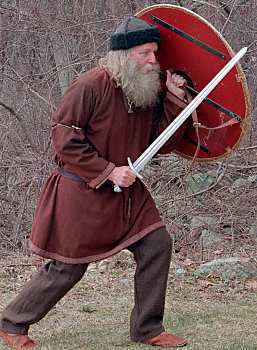

Halberd, Pole-Axe - These long-hafted weapons were complete weapon systems for the medieval infantryman, and enjoyed popularity with high and low-born alike. They were equally adept at armored and unarmored opponents, frequently with crushing, chopping and spiked-stabbing surfaces for whatever the situation required and edges to hook, catch and trip an opponent.
Lance - This is the king of the medieval battlefield. A lance charged from horseback was devastating to anything in front of it. The d12 represents a mounted charge. A lance on foot, or used from a stationary position is just an awkward spear (d8 as above).
Zweihander - the true two-hander, six foot of steel nearly as much pole-arm as sword. These were made famous by the Landsknecht mercenaries. Too modern for all but the latest settings, I thought I would include it anyway for the sake of completion.
Shields Are Weapons
A lot of games either how shields were used, or never knew in the first place, but they were frequently as offensive as they were defensive. Assume that bucklers, round shields and heater shields can be used to bash and cut as weapons, using the Strike skill the same as any other weapon. Kite shields have been intentionally left out, however. The trade off for that much protective coverage is a shield too unwieldy to make a useful weapon.
If you worry that this makes shields "too good" by comparison, consider house-ruling that offensive shield attacks are made at one die lower (d6 attack from a buckler, for instance). Alternatively, you could declare that shields can only be used for maneuvers rather than attacks. This is also valid, though a saxon shield could crack a rib pretty easily if one knew what they were doing.
Friday, October 24, 2014
Chronica Feudalis: Armor Expansion
I'm a history nerd. There is no denying it. While I enjoy fantasy, my real passion is for the mud-and-blood of low-fantasy or historical fiction. Chronica Feudalis rules actually handle this pretty well, if one is willing to color their narration to taste, but since I have a thing for historical detail I thought I would spice things up.
Today's post will be the first in a series on adding some extras to Chronica Feudalis, starting with Armor. As always, your mileage may vary, but after a relatively decent amount of testing this held up nicely.

Armor Expansion
This revised edition makes a few changes. The original table for Chronica Feudalis read as follows:
First, when a helm is worn in addition to armor, it will stack with the armor you already have. Wearing a helm or coif will increase your armor die by 1 step. Thus, a hauberk and a helm count as d10 armor. This d10 will be both your armor die when being attacked, and the armor die you'd have to endure in appropriate circumstances.
This was chiefly done because I didn't like the idea of an Ardor cost for your helmet to work. Few people seemed interested in spending a point to gain d4 under any circumstances, and it granted the weirdest mental image of trying to headbutt an arrow. Under the previous rules, the iconic great helm was more trouble than it was worth - rarely a benefit, but frequently a hindrance.
Whether you're using a half-helm or coif (both d4) or a full helm (d6), you get the same 1 step bump to your armor die. However, to account for the difference between the two kinds of headgear
Great Helm - Expanded to include all closed-face helms and great-helms. Many of these have a visor that can be opened for better vision (and breathing). When these are open, they count as half-helms but still incur the hearing penalty.
Coat of Plate (or Brigandine) - This was a transitional armor that came into prominence in the late thirteenth and early fourteenth century. It consisted of steel plates riveted into the inside of a leather doublet, usually faced with some kind of fabric. The idea of a "studded leather" armor actually comes from a misunderstanding of what this garment is. On it's own, it provides the d8 armor listed above. More commonly, it was worn over maille. When worn with a maille hauberk, the armor stacks and bumps up to d10. This also stacks with headgear. A knight with Sallet, coat of plate, and hauberk will have d12 armor.
Full Plate Harness - This is the full suit of plate (not "plate mail." Maille only refers to the chain-link material) that marks the high-point of armor development in the western tradition. Yes, it's a big jump from d12 to d20, but keep in mind that the closer we get to Plate, the more pole-arms and two-handed swords became the norm as knightly weapons. the d20 represents this well. We also know that it was damn hard to kill someone in plate unless you had them on the ground and could pierce one of the joints in the armor. On the flip-side, enduring that d20 is going to be a good deterrent to people living in plate and in reality it was rarely worn outside of tourneys or pre-planned battles. As a side note, this assumes a helm is worn, as the helm would be made to fit the armor like any other piece of the suit. The helm does not increase the armor rating, but the d6 penalty may still apply for hearing/vision tests where appropriate.
Today's post will be the first in a series on adding some extras to Chronica Feudalis, starting with Armor. As always, your mileage may vary, but after a relatively decent amount of testing this held up nicely.
Armor Expansion
This revised edition makes a few changes. The original table for Chronica Feudalis read as follows:
d4 | A leather jerkin, a gambeson, a maille coifHelms and Stacking
d6 | Hardened leather cuirass, a helm
d8 | Maile hauberk
d10 | Scale coat
First, when a helm is worn in addition to armor, it will stack with the armor you already have. Wearing a helm or coif will increase your armor die by 1 step. Thus, a hauberk and a helm count as d10 armor. This d10 will be both your armor die when being attacked, and the armor die you'd have to endure in appropriate circumstances.
This was chiefly done because I didn't like the idea of an Ardor cost for your helmet to work. Few people seemed interested in spending a point to gain d4 under any circumstances, and it granted the weirdest mental image of trying to headbutt an arrow. Under the previous rules, the iconic great helm was more trouble than it was worth - rarely a benefit, but frequently a hindrance.
Whether you're using a half-helm or coif (both d4) or a full helm (d6), you get the same 1 step bump to your armor die. However, to account for the difference between the two kinds of headgear
- Full Helms hamper your hearing and vision (when the visor is down, when applicable) and must be endured under these circumstances, but prevent any kind of injury specific to the face.
- Coifs (and Half Helms, added in this expansion) do not hamper vision or hearing, but do not protect the face in the way that Full Helms do.
d4 | A leather jerkin, a gambeson, a mail coif, half-helm (kettle helm, and so on)Half Helm - This represents all manner of open-faced metal helms that were popular among every class throughout the middle ages. We covered stacking above, so I won't bother going into it again.
d6 | Hardened leather cuirass, great helm (sallet, etc)
d8 | Mail hauberk, Coat of Plate
d10 | Scale coat
d20 | Full Plate Harness
Great Helm - Expanded to include all closed-face helms and great-helms. Many of these have a visor that can be opened for better vision (and breathing). When these are open, they count as half-helms but still incur the hearing penalty.
Coat of Plate (or Brigandine) - This was a transitional armor that came into prominence in the late thirteenth and early fourteenth century. It consisted of steel plates riveted into the inside of a leather doublet, usually faced with some kind of fabric. The idea of a "studded leather" armor actually comes from a misunderstanding of what this garment is. On it's own, it provides the d8 armor listed above. More commonly, it was worn over maille. When worn with a maille hauberk, the armor stacks and bumps up to d10. This also stacks with headgear. A knight with Sallet, coat of plate, and hauberk will have d12 armor.
Full Plate Harness - This is the full suit of plate (not "plate mail." Maille only refers to the chain-link material) that marks the high-point of armor development in the western tradition. Yes, it's a big jump from d12 to d20, but keep in mind that the closer we get to Plate, the more pole-arms and two-handed swords became the norm as knightly weapons. the d20 represents this well. We also know that it was damn hard to kill someone in plate unless you had them on the ground and could pierce one of the joints in the armor. On the flip-side, enduring that d20 is going to be a good deterrent to people living in plate and in reality it was rarely worn outside of tourneys or pre-planned battles. As a side note, this assumes a helm is worn, as the helm would be made to fit the armor like any other piece of the suit. The helm does not increase the armor rating, but the d6 penalty may still apply for hearing/vision tests where appropriate.
Thursday, October 23, 2014
Aging Gracefully: Creating Veteran Characters in Chronica Feudalis
Like many games, Chronica Feudalis seems to take the default assumption that the starting characters are fresh-faced twenty-somethings with the whole world ahead of them. Sometimes though, you want someone who has a little more age and experience under their belt. The simplest way to do this within the framework of the rules is to simply give the character the Grizzled Veteran or Old and Wise aspects, and go with that. However, if you want a more crunchy option that will give that choice a little more umph, I present the following:
Veteran Characters
Not every character's story starts at 25. Players who want to begin as a more advanced and experienced protagonist may opt to use one of the Aspect slots to do so. At character creation, you may take an age aspect in exchange for additional points to advance your skills.
A Middle Aged (d8) character gains 3 additional points to advance their skills with. These can be used to advance skills gained from their mentors, or other skills they may have picked up along the way. These points work the same way as mentor overlapping, advancing the die by one step. A d4 becomes a d6, d6 becomes a d8, and so on. This assumes a character in his late 30s, or early 40s.
An Elderly (d12) character gains 6 total points to advance their skills with. This is not cumulative with the Middle Aged character points. As above, these may be allocated as you please. An Elderly character is considered to be someone in his late 50s or beyond.
Characters who are races that age differently than humans should obviously adjust the age categories to match (an Elderly dwarf being in his hundreds). Also, bear in mind that while you could use this to get that maximum Brawl or Strike, your Elderly aspect may well be invoked against you.
The die from the above age aspects can never be reduced barring magical intervention, but may be increased as normal.
 |
| The Old Bear, by ReneAigner |
Not every character's story starts at 25. Players who want to begin as a more advanced and experienced protagonist may opt to use one of the Aspect slots to do so. At character creation, you may take an age aspect in exchange for additional points to advance your skills.
A Middle Aged (d8) character gains 3 additional points to advance their skills with. These can be used to advance skills gained from their mentors, or other skills they may have picked up along the way. These points work the same way as mentor overlapping, advancing the die by one step. A d4 becomes a d6, d6 becomes a d8, and so on. This assumes a character in his late 30s, or early 40s.
An Elderly (d12) character gains 6 total points to advance their skills with. This is not cumulative with the Middle Aged character points. As above, these may be allocated as you please. An Elderly character is considered to be someone in his late 50s or beyond.
Characters who are races that age differently than humans should obviously adjust the age categories to match (an Elderly dwarf being in his hundreds). Also, bear in mind that while you could use this to get that maximum Brawl or Strike, your Elderly aspect may well be invoked against you.
The die from the above age aspects can never be reduced barring magical intervention, but may be increased as normal.
Wednesday, October 22, 2014
Chronica Feudalis: Nobility House Rules
Chronica Feudalis makes the default assumption that all of the protagonists are all peasants (maybe even yeomen, if your setting is far enough in time) and suggests that if you're interested in some kind of status, you can add it via background. If you're wanting something with a little more swagger in your social status, then here are some optional rules you can try out.

Playing Nobility
Like everything that makes your character truly special or interesting, CF handles this aspects. While vanilla CF makes passing mention of a character with the Fearless Knight, the subject isn't strictly addressed in a broader social way. There are two distinct methods I'm going to use here, House Affiliation, and Status
House Affiliation
House affiliation represents a character whom is a member of a specific noble family, whether they are the reigning lord (duke, etc), an heir or other family member. You can take this aspect directly (Scion of House Blackwell) or phrase it in such a way to imply reputation ("A Lannister always pays his debts.").
In addition to being able to invoke this aspect in any normal way (most often rolls to influence another party), you may also invoke your House aspect when making purchase rolls to represent letters of credit or resources tied up in your family holdings. Note however, that all of the rules that apply to the purse also apply to your House die, including the conditions for step reduction. This represents the loss of influence that comes as debts pile up and rumors fly ("Did you hear that the Blackwells had to sell off part of their lands to settle their son's tournament losses?"). A careless noble could spend his family into ruin.
If several characters belong to the same noble house, they share this Aspect. As the wealth and influence dwindles, it affects all of the characters with the die, rather than each individual separately. Aspect dice spent this way can't be raised at the end of the session as others can. Instead, they rely on the actions of the characters in the setting. If the letcherous son of Bywin Flannister begins to empty the family's coffers with whoremongering and folly, it may be up to the father to eliminate a rival or win political favor to restore the family name (and thus bring their die back up).
While not strictly nobility, players wishing to simulate rich merchant characters or others whose wealth and influence is otherwise tied up in lands or industry can use a similar approach.
Status
Certain characters may not have access to land and wealth in the same fashion that some of the great houses do, but they may have some of the trappings of nobility all the same. Characters who can claim title or a badge of office ("Reeve of Curthshire," "Captain of the Debra Sanchez," "First Sword of Braavos") may take that trapping as an aspect. Many who were noble by blood placed themselves in the service of other nobles or the church, with no income of their own. Taking such aspects as Sworn Knight or Priest of Recursivous, The God of Priests can represent this well.
These aspects functions in nearly all ways similarly to the aspects as written in the core book, and may not be used to leverage wealth. However, they can still come with a prestige of their own and can be used to influence others. Characters wishing to do so should tread carefully, however. No matter how high your die, invoking your title against someone above your station will not only do you little good (invoking Priest of St. Cthulhu's Cathedral has no effect on the abbot, nor on the king), but may well provoke their wroth.
Monday, October 20, 2014
My Love Affair with Chronica Feudalis
Chronica Feudalis carries for me the title of "Best Game Ever Forgotten." It's one of those little gems that sets a goal for itself and follows through elegantly.

The game sets out to be a historical RPG, and the text under the clever premise that the original authors were monks passing the long, dull hours of monastic life, complete with a foreward by the translator, and translators notes within the text itself. The game works in a way very similar to FATE, in that it's based on the invoking and evoking of Aspects, but it develops the concept in different ways. It's a bit more focused than FATE, and also has its own die scheme that is elegant in its own way.
Chronica Feudalis is a very tight little machine. It plays quick and easy, and with the FATE-like method of damage resolution, can be as forgiving or bloody as the group desires. Character creation is quick and dirty, with characters essentially picking up to three "mentors" that determine their collective skills at the start of play, such as Artisans, Courtiers, Knights, Minstrels, Peasants, Thieves, etc, in effect making each character a gestalt of the three classes chosen. The three mentors also determine starting equipment and funds, so character creation takes practically no time at all. This can be a little restricting, but individualization can easily be done through choice of Aspects, and additional kit can be bought during play. Of note though, the Mentors aren't just classes - they are expected to be brought in as NPCs from the start, helping the character to not just have a background, but to actively fit into the world.
I played quite a bit of CF over the years, and I'll be posting some of my house rules as I get a chance. Definitely worth trying out though, particularly with the hacks floating around out there. Some of my favorites are by Nathan at Platonic Solid, who managed to both expand the scope of play some, and made an excellent fantasy hack for the system. Posts of particular note are:
Earlier, I called Chronica Feudalis the best game ever forgotten, and I think this is the most tragic thing about it. As much potential as it has as a simple system, the author seems to have forgotten about it entirely. The last post on the subject was back in 2010, wherein was Keller was beginning to hype the expansion book Noblesse Oblige. Some time thereafter he ran a kickstarter for Tech Noir, and the project seems to have disappeared off the map. A true shame.
I can only hope that he decides to come back to it one day. With several more years of design, and several additional projects under his belt, I'd look forward to seeing what he would do with the expansion.
Until then,
The game sets out to be a historical RPG, and the text under the clever premise that the original authors were monks passing the long, dull hours of monastic life, complete with a foreward by the translator, and translators notes within the text itself. The game works in a way very similar to FATE, in that it's based on the invoking and evoking of Aspects, but it develops the concept in different ways. It's a bit more focused than FATE, and also has its own die scheme that is elegant in its own way.
Chronica Feudalis is a very tight little machine. It plays quick and easy, and with the FATE-like method of damage resolution, can be as forgiving or bloody as the group desires. Character creation is quick and dirty, with characters essentially picking up to three "mentors" that determine their collective skills at the start of play, such as Artisans, Courtiers, Knights, Minstrels, Peasants, Thieves, etc, in effect making each character a gestalt of the three classes chosen. The three mentors also determine starting equipment and funds, so character creation takes practically no time at all. This can be a little restricting, but individualization can easily be done through choice of Aspects, and additional kit can be bought during play. Of note though, the Mentors aren't just classes - they are expected to be brought in as NPCs from the start, helping the character to not just have a background, but to actively fit into the world.
I played quite a bit of CF over the years, and I'll be posting some of my house rules as I get a chance. Definitely worth trying out though, particularly with the hacks floating around out there. Some of my favorites are by Nathan at Platonic Solid, who managed to both expand the scope of play some, and made an excellent fantasy hack for the system. Posts of particular note are:
Chronica Feudalis Fantasy Hack - Wherein he sets up some basic premises for modeling orcs and other baddies.I got so much expanded play out of these extras that I would consider them essential for anything but the most historically-based games.
Chronica Feudalis Fantasy Hack: Scaling - Where he works out how to represent dragons and the like with the system.
Chronica Feudalis Fantasy Hack: Magic - which adds a flexible, fully functional magic system to the game.
Earlier, I called Chronica Feudalis the best game ever forgotten, and I think this is the most tragic thing about it. As much potential as it has as a simple system, the author seems to have forgotten about it entirely. The last post on the subject was back in 2010, wherein was Keller was beginning to hype the expansion book Noblesse Oblige. Some time thereafter he ran a kickstarter for Tech Noir, and the project seems to have disappeared off the map. A true shame.
I can only hope that he decides to come back to it one day. With several more years of design, and several additional projects under his belt, I'd look forward to seeing what he would do with the expansion.
Until then,
Subscribe to:
Posts (Atom)